Part 8 – Schema
This is a series of posts I’m writing about using types as another tool in software development, Continuous Delivery, & keeping LLM’s honest. They’re also a design & refactoring tool, a communication tool, and reduce how many tests you have to write.
Parts
- Part 1 – Branded Types
- Part 2 – Product Types
- Part 3 – Union & Discriminated Unions
- Part 4 – Non-Empty Collections
- Part 5 – Indexed Types
- Part 6 – unknown vs any
- Part 7 – Result
- Part 8 – Schema
- Part 9 – Total Function
- Part 10 – Errors as Values
- Part 11 – Property Tests
- Part 12 – Type Proofs
- Part 13 – Exhaustiveness Checking
- Part 14 – Parse, Don’t Validate
- Part 15 – Anti-Corruption Layer
- Part 16 – Opaque Types
- Part 17 – Maybe
- Part 18 – Smart Constructors
- Part 19 – Pipeline
- Part 20 – Railway Oriented Programming
- Part 21 – Typestate
- Part 22 – Capabilities
- Part 23 – Immutability
- Part 24 – Making Impossible States Impossible
- Part 25 – Type Driven Development: How to do it
- Part 26 – Final Thoughts
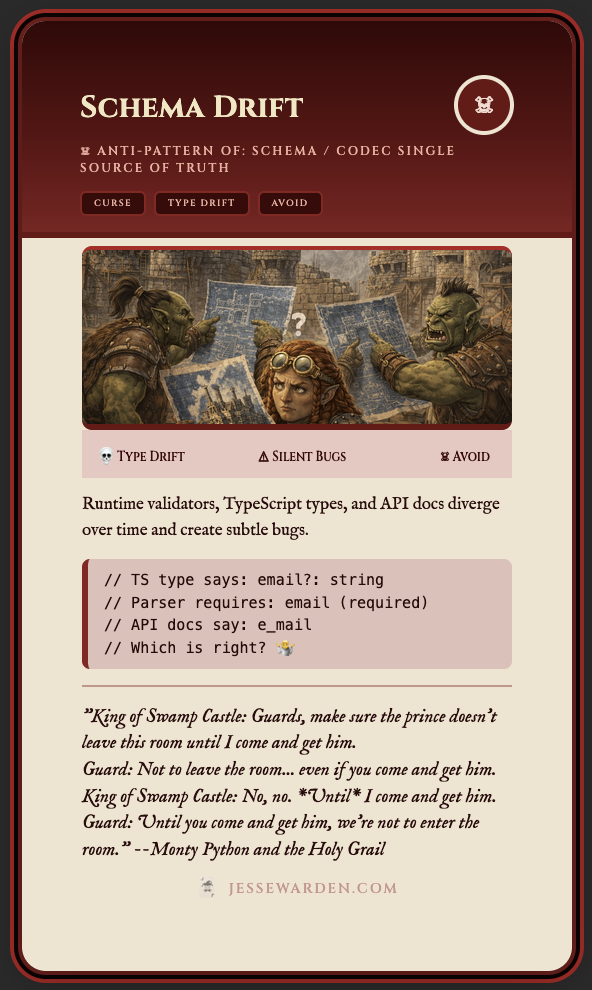
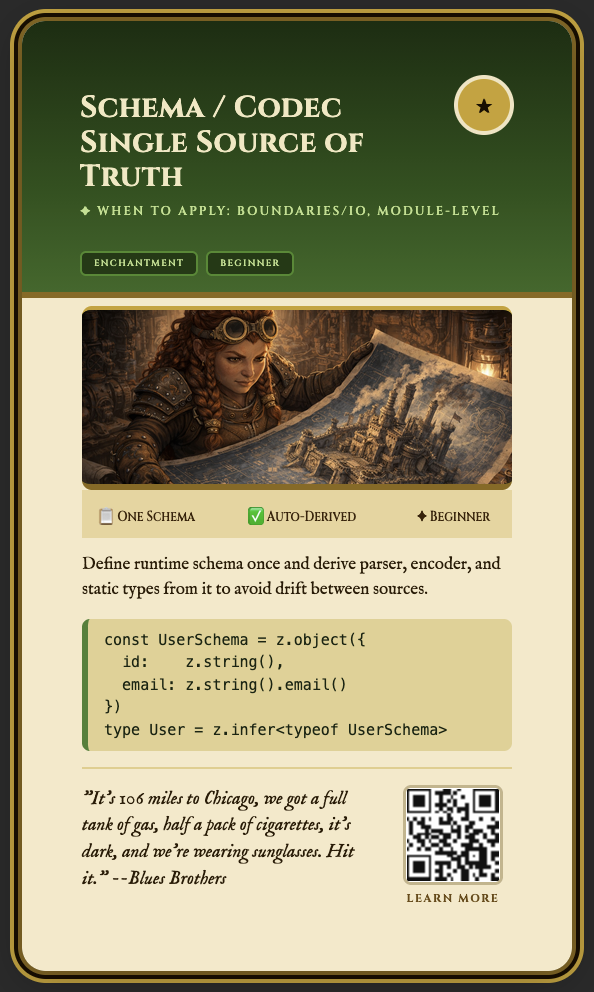
To do anything of value in software, we have to get unsafe data from outside our type system into it. We saw how unknown forces us to type narrow, but type narrowing is dangerous, tedious, and it’s hard to be thorough.
(more…)